DESCRIPTION:
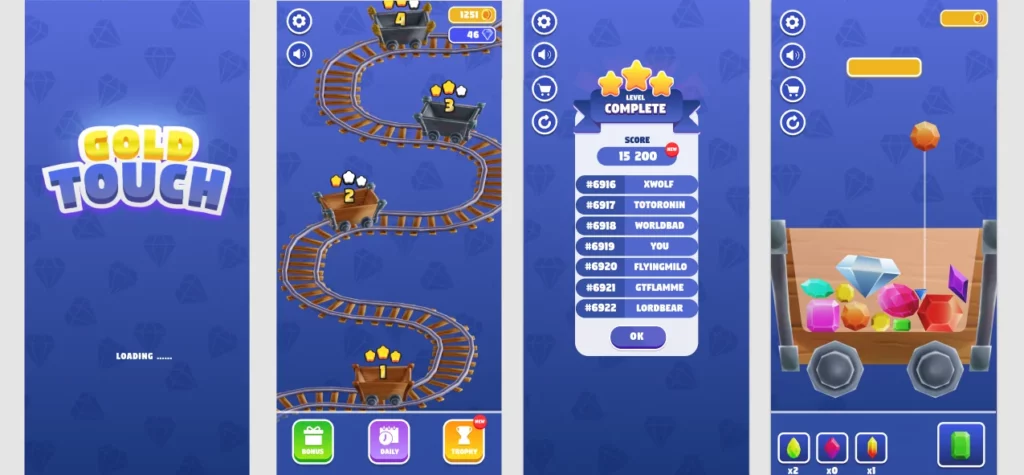
Gold Touch is a casual mobile puzzle game built in four weeks by a team of four, then released on the Play Store in November 2024. Beyond the game itself, the exercise was about everything that surrounds a mobile launch: monetisation, user acquisition, A/B testing and reading the data.
INFO:
Project type: Mobile game
Year: 2024
Platform: Android (Play Store)
Duration: 4 weeks
Team: 4 people
Role: Game Designer · Technical integration · User acquisition
Context: Student project released in real conditions
What I did on the project
My role quickly went beyond pure game design. On top of puzzle design and balancing, I took on a large share of what actually makes a mobile game shippable:
- Technical integration: wiring up the APIs, setting up the A/B testing system and in-app purchases.
- Balancing: difficulty progression and in-game economy.
- Acquisition and communication: building the Play Store listing, defining the communication strategy and running the ad campaigns.
- Publishing: submitting builds for Google review and following the process through to release.
What worked
The game shipped, it was playable, and it found a few players: around a hundred downloads in the first week, off a few thousand views on our ads.
But the real value of the project lies elsewhere. It was the first time I put a genuine data-driven decision practice in place: instrumenting the game, running A/B tests, looking at what players actually did rather than what we assumed they would do. On my other projects, feedback mostly came from playtests I could watch live. Here, I had to learn to read curves and turn them into design decisions.
What worked less well
The make-up of the team. None of my teammates came from games. It showed in our execution speed and, above all, in the polish. The result works as a proof of concept, but stops there.
Too many bugs to judge retention. There was no way to draw anything reliable from the retention figures: players were leaving because of technical issues, not design choices. The onboarding also had too much friction, losing a share of players before they even understood the game.
Too small a sample, too short a window. Four weeks to design, build, ship and analyse is enough to learn the mechanics of a mobile release, not to seriously exploit the data. With more time and more players, the A/B testing could have produced genuinely actionable conclusions.
What I take away from it
Gold Touch remains my only project to have gone through the full cycle of a mobile release, Google review included. It is a very different context from PC production or physical games: retention constraints, acquisition cost and onboarding friction drive design far more there than on other formats.
It is also the project that gave me the reflex of instrumenting what I design, a reflex I have kept ever since.
Edit – August 2026
Gold Touch has been off the Play Store since May 2026. The school does not keep its games on its developer account beyond two years: once we graduated, the slot was freed up for the following cohorts.
Taking the listing down also cost me access to the console: the precise acquisition campaign numbers, conversion rates and retention curves are no longer available. The rough figures quoted above are what I have left, so this note stays deliberately qualitative on that front.
The game is still viewable on its itch.io page: timeolebot.itch.io/gold-touch